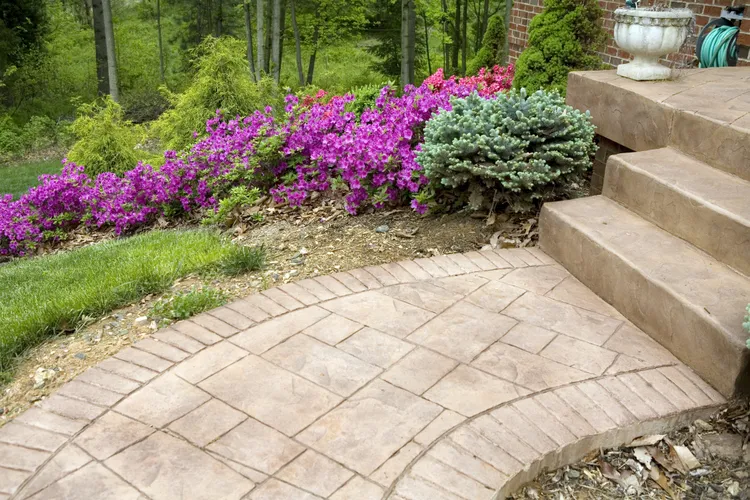
Front yard elements shouldn’t be ignored, chief among them the walkway leading to the home entrance: This seemingly insignificant path not only serves a function, but it also impacts curb appeal and welcomes guests.
If you’re laying down a new walkway or redoing the front yard for yourself, your visitors, or for resale, you’d best avoid the following faux pas, according to designers.
Lack of Landscaping
A completely bare walkway can appear stark and uninviting to visitors, so you should always aim to implement landscaping, even if minimal.
“While it’s tempting to play it safe with neatly trimmed shrubs in a straight line, don’t miss the opportunity to create something with a bit more depth and interest,” AnnBritt Newey, director of interior design at Phinney Design Group, says. “A layered, thoughtful planting plan can soften the space and make it feel more inviting.”
If you’re going to plant alongside your walkway, you should commit to doing the entire path, according to Laura Janney, a gardening expert and the CEO of The Inspired Garden. You don’t need to line both sides of the path with potted plants or flower beds nor do you have to plant in abundance. However, leaving big sections bare and unplanted can make the design look like an afterthought.
Also, beware: A more layered, lush look can get expensive very quickly. If this is what you’re after, but you need to stay within a modest budget, Janney suggests focusing on the parts nearest the front door as that’s where the eyes are naturally drawn. And such a design tends to look more intentional.
Walkway Proportions
If a short walkway is giant and sprawling in width, it can look out of place and commercial. On the other side, if a long walkway is narrow and winding, it can look like an afterthought, Jonathan Gordon, lead designer and owner of Design by the Jonathans, says.
“The width of a walkway versus its length, location, and setting can easily make it feel unwelcoming, so before putting in a new one, stake it out on your property to get a feel for the proportions,” Gordon says.
Also, keep in mind that walkways that are too narrow both look and feel awkward. Not to mention, it’s less functional, especially if visitors are attempting to pass each other on the path. The general rule of thumb is to make it wide enough to allow two people to walk side-by-side comfortably, which is approximately 4 feet wide.
You might need to increase the width for accessibility (for residents or visitors who have mobility issues and/or use wheelchairs). A wider walkway also helps create a more welcoming feel.
Poor Maintenance
A walkway or yard that’s unkempt, uneven, dirty, or damaged in any way can be an eyesore, as well as a tripping hazard in some cases.
“Grass and weeds can creep up over stone, and moss can develop in the mortar, so some quick weeding or even a power-washing can work wonders,” Gordon says.
In addition to weeding, look out for and remedy overgrown plants, tree roots, broken sections, or sinking and loose pavers. Don’t forget to sweep (or wash) the walkway to rid it of debris, stains, discoloration, oil, or bird droppings.
You might also want to consider resealing the walkway if the general cleanup doesn’t improve the walkway’s appearance. Before you proceed, always research how to properly treat the material (e.g. concrete, bricks, natural stone), and what types of cleaners and sealants are safe to use on them.
Cheap Lighting
Gordon explains how, although a well-lit walkway is important, cheap plastic lights like solar ones can really diminish the look and feel of the property.
They often don’t have deep enough posts to avoid being tipped over or knocked askew, adding to the problem. He suggests spending the money to go for a permanent solution, which entails wiring from your house and nice metal fixtures that will last.
Busy or Mismatched Design
The walkway can be pristine, but if it looks out of place in front of your home, it can detract from your home’s curb appeal. Mismatched materials, in that they don’t go with the house’s aesthetic and front-yard landscaping, can be unsightly as well. For instance, sleek and minimal large-scale concrete pavers leading up to the door of a turn-of-the-century Tudor or Victorian will likely look off and take the curb appeal down a few notches.
“Overall, a walkway should feel cohesive with the design and landscape of the home, not like it’s competing for attention,” Janney says.
Walkways paved with too many colors or competing patterns can feel visually chaotic, according to Newey. Aim to simplify the palette and select timeless materials to bring everything into harmony.
She adds that while a little personality goes a long way, too many ornamental objects—like whimsical sculptures or windmill-style garden accents—can distract from the architecture instead of enhancing it.